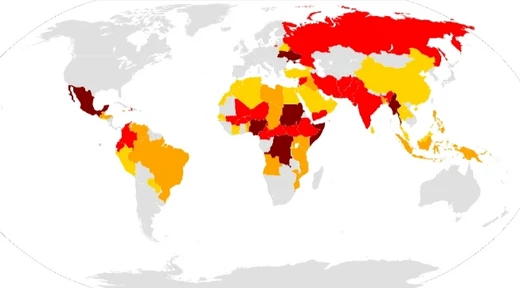
First Ivorian Civil War

glichfield · CC BY-SA 2.0
The conflict pitted the government of Ivorian President Laurent Gbagbo against a domestic insurgency led by the New Forces of Ivory Coast.
- location
- Ivory Coast (Côte d'Ivoire)
- belligerents
- Government of President Laurent Gbagbo vs. New Forces of Ivory Coast
- outcome
- Ouagadougou Peace Agreement signed; de facto partition ended
Lore & Background
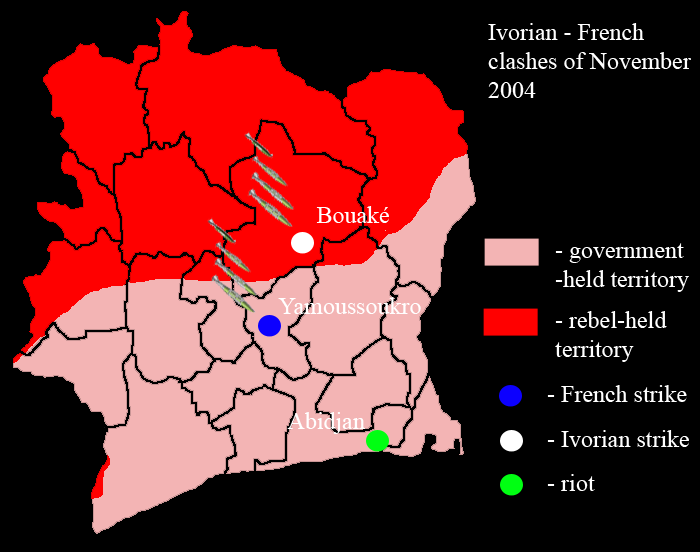
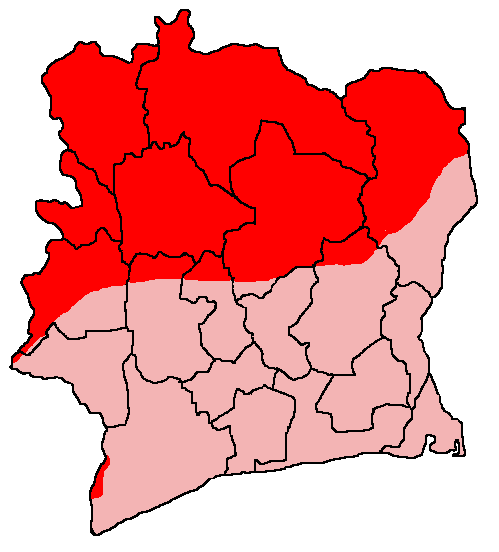
Three successive leaders – Henri Konan Bédié, Robert Guéï, and Laurent Gbagbo – exploited the ideology of Ivoirité to repress political opposition, disqualifying Alassane Ouattara from elections on the basis of his Burkinabé nationality, stoking ethnic tensions and xenophobic sentiment. Though they failed to take Abidjan, rebels quickly established control over much of the north. Across the country, opposition supporters clashed with pro-government militias like the Young Patriots.
Reader's Guide
The First Ivorian Civil War was significant as a violent manifestation of a prolonged political crisis rooted in contested citizenship and ethnic polarization. The conflict also highlighted the destabilizing role of Ivoirité ideology and the challenges of post-colonial state-building in West Africa. International interventions by France and the United Nations, while aimed at peace, were controversial and sparked nationalist backlash.
Did You Know?
- France launched a military intervention called Opération Licorne soon after the initial rebellion.
The Succession Crisis That Shattered Stability
The constitution handed power to Henri Konan Bédié, then President of the National Assembly, who also took the helm of the ruling Democratic Party of Ivory Coast. But the country had no deep institutional machinery to manage democratic competition.
Ivoirité and the Politics of Exclusion
The Ivory Coast had long attracted immigrants from neighboring West African states, particularly Burkina Faso, a flow sustained by the country's relative prosperity and Houphouët-Boigny's open policies. After Houphouët-Boigny's death, however, three successive leaders—Bédié, Robert Guéï, and Gbagbo—weaponized the concept of Ivoirité to marginalize political rivals. The most consequential act was the disqualification of Alassane Ouattara from running in elections on the grounds of his Burkinabé nationality. This exclusionary citizenship framework stoked ethnic tensions and xenophobic sentiment across the country.
The September 2002 Uprising and Territorial Fragmentation
Although the rebels failed to capture Abidjan, they rapidly seized control over much of the country's northern territory. Meanwhile, along the Liberian border, two additional insurgent groups—the Movement for Justice and Peace and the Ivorian Popular Movement of the Great West—engaged government forces in fighting over western regions. Across the country, clashes erupted between opposition supporters and pro-government militias, including the Young Patriots. The conflict quickly drew in external actors: France, the former colonial power, launched a military intervention under the banner of Opération Licorne, claiming a protective and neutral mandate.
Failed Reconciliation and the Shadow of 2010
The country lingered in a state of de facto partition, with the political crisis unresolved. Yet the peace proved fragile.
Gallery
Frequently Asked Questions
Who were the main belligerents in the First Ivorian Civil War?
The conflict pitted the government forces loyal to President Laurent Gbagbo against a domestic rebel coalition known as the New Forces of Ivory Coast.
How did the First Ivorian Civil War end?
The conflict was resolved through the Ouagadougou Peace Agreement, which ended the de facto partition of the country that had developed during the war.
More in Military Conflicts And Wars 1-18
Spotted an error? Know more?
This is a living reference — every entry is fact-audited, and reader corrections feed straight into our audit queue. Suggest an edit · See this site's audit record