First Matabele War

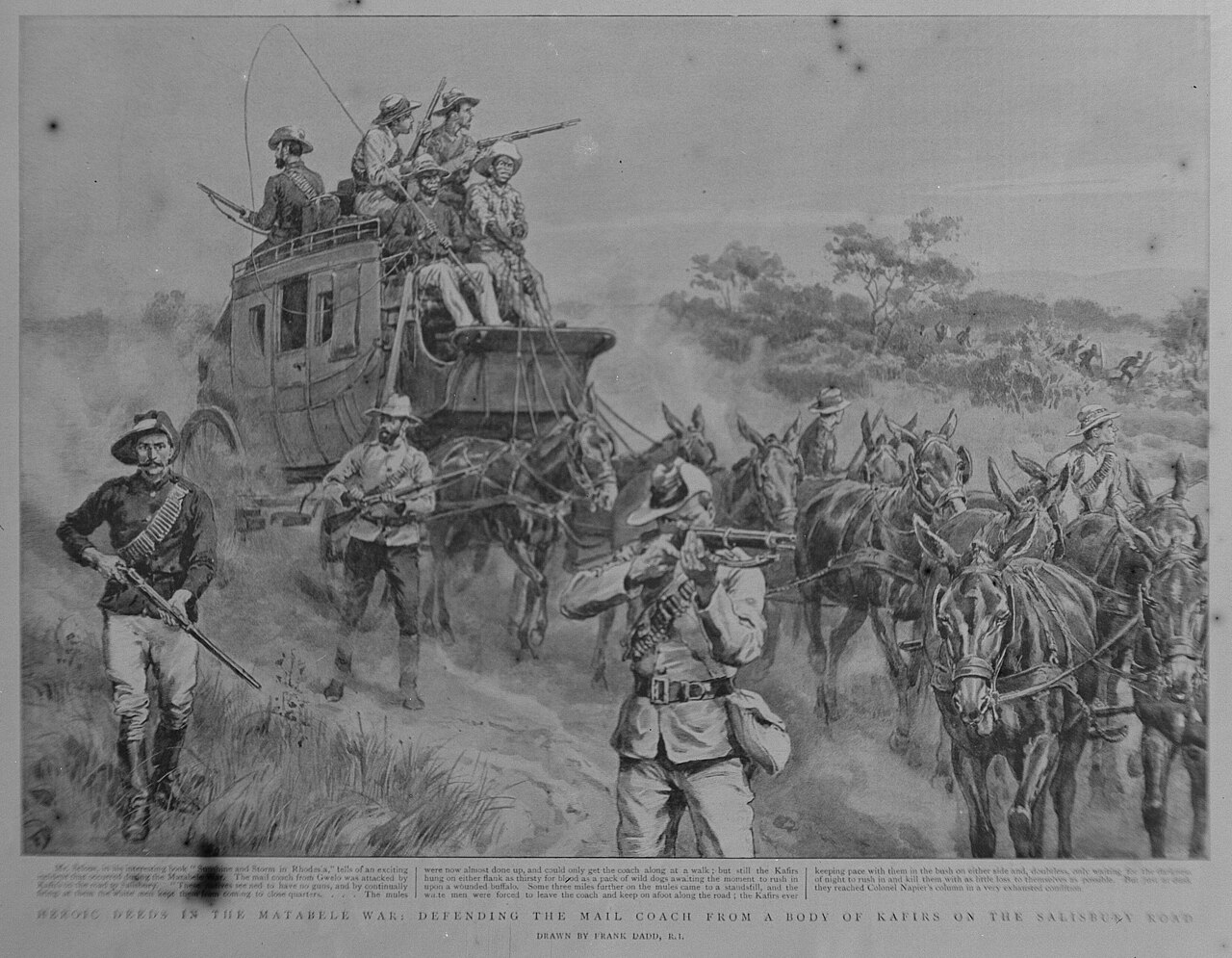
Jacob Olie / Frank Dadd · Public domain
It pitted the British South Africa Company against the Ndebele kingdom of Mthwakazi. The conflict arose from tensions over territorial control and tribute raids, culminating in a decisive British victory that led to the destruction of the Ndebele capital and the death of King Lobengula.
- Conflict
- First Matabele War
- Location
- Modern-day Zimbabwe (Matabeleland and Mashonaland)
- Belligerents
- British South Africa Company vs. Ndebele kingdom of Mthwakazi
- Key Figures
- Lobengula (Ndebele king), Cecil Rhodes (Cape Colony PM), Leander Starr Jameson (Administrator of Mashonaland), Major Patrick Forbes (BSAP commander)
- Outcome
- British South Africa Company victory; Ndebele submission
Lore & Background
King Lobengula of Mthwakazi tried to avoid war with the British South Africa Company, mindful of the destructive power of European weapons. Matters came to a head when Lobengula approved a raid to extract tribute from a Mashona chief near Fort Victoria, leading to a clash with the company.
Reader's Guide
The First Matabele War demonstrated the devastating impact of industrial-era weaponry, particularly the Maxim machine gun, on traditional African armies. The war enabled the British South Africa Company to consolidate control over the territory that would become Southern Rhodesia. The conflict also sparked controversy in Britain, with charges that the company provoked the war to seize land, though an inquiry exonerated the company. The war's legacy includes the destruction of the Ndebele kingdom and the establishment of colonial rule, shaping the region's history for decades.
Did You Know?
- The Maxim machine gun was used in battle for the first time during the First Matabele War, mowing down Ndebele warriors 'literally like grass'.
- After the Battle of Bembesi, Lobengula fled Bulawayo and his subjects torched the royal town, destroying a large store of ivory, gold, and other treasure.
- Two officers' batmen were accused of accepting a box of gold sovereigns meant to bribe the British column, but the evidence was inconclusive; they were sentenced to 14 years' hard labour but released after two years.
Colonial Roots and the Road to Uprising
The conflict in Rhodesia was rooted in the late 19th-century conquest by the British South Africa Company and the resistance of indigenous leaders to foreign domination. The political landscape shifted dramatically when UK Prime Minister Harold Macmillan delivered his 'Wind of Change' address, signaling that African colonies would only achieve independence under majority rule.
Superpower Rivalry and the Global War
The Rhodesian conflict became entangled in Cold War geopolitics, with the Soviet Union backing ZIPRA and China supporting ZANLA. Each guerrilla force waged its own campaign against Rhodesian security forces, and the two nationalist armies occasionally clashed with one another as well. North Korean military instructors trained Zimbabwean fighters in explosives and weapons handling at a camp near Pyongyang. On the other side, South Africa provided covert material and military aid to the Rhodesian government. The United States officially refused to recognize Rhodesian independence, yet some American veterans of Vietnam enlisted in the Rhodesian Security Forces.
The Internal Settlement and Its Collapse
However, this new political structure failed to secure international recognition, and armed fighting continued unabated. Neither the government nor the guerrilla movements achieved a decisive military victory, making compromise the only viable path forward.
Ideological Framing and the Fight for Legitimacy
The Rhodesian Front, the ruling party under Ian Smith, adopted an uncompromising stance against what it characterized as the communist ideology driving both ZIPRA and ZANLA. Smith deliberately framed the conflict as an anti-communist struggle, a rhetorical choice that allowed the white minority government to strengthen its ties with Western nations, even as Britain maintained a position of neutrality. White Rhodesians perceived the British demand for majority rule as an existential threat to their way of life, a fear sharpened by their memory of the Mau Mau Rebellion in Kenya. Much of the Rhodesian economy and land remained under white control, and the ruling party, fearing wholesale confiscation by either nationalist movement, chose to preserve unofficial minority rule. This ideological framing, however, obscured other significant drivers of the conflict, particularly the stark wealth disparities between the races that African nationalists had long decried. The communist-versus-anti-communist divide also caused the fighting to spill beyond Rhodesian borders, as neighboring African nations, bolstered by material support from North Korea, China, and the Soviet Union, launched guerrilla attacks against Rhodesian security forces, civilians, and infrastructure.
Gallery
Frequently Asked Questions
What was the First Matabele War?
It was a short but decisive military clash in which the British South Africa Company confronted the Ndebele kingdom of Mthwakazi over disputes involving territorial dominance and tribute. The war concluded with a clear British victory and the forced submission of the Ndebele people.
Who were the key figures in the First Matabele War?
King Lobengula headed the Ndebele side, while the British effort was driven by Cecil Rhodes, Leander Starr Jameson as administrator of Mashonaland, and Major Patrick Forbes, who led the BSAP field force.
How did the First Matabele War end?
British Maxim guns proved overwhelmingly effective on the battlefield, breaking Ndebele resistance. The conflict closed with the destruction of the Ndebele capital, the death of King Lobengula, and the kingdom's formal capitulation to British authority.
Why is the First Matabele War historically significant?
It effectively ended Ndebele political sovereignty and cleared the path for broader British colonial expansion across southern Africa. The war also highlighted how industrialized firearms could decisively tip the balance in African military confrontations.
More in Military Conflicts And Wars 1-18
Spotted an error? Know more?
This is a living reference — every entry is fact-audited, and reader corrections feed straight into our audit queue. Suggest an edit · See this site's audit record