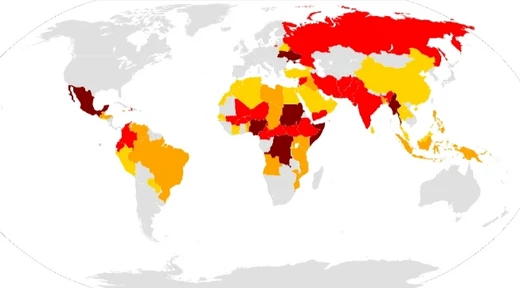
Football War

Tony Webster · CC BY 2.0
The Organization of American States (OAS) negotiated a cease-fire on the night of 18 July. Salvadoran troops were withdrawn in early August. The war, while brief, had major consequences for both countries and was a major factor in starting the Salvadoran Civil War a decade later.
- Conflict
- Football War
- Belligerents
- El Salvador vs. Honduras
- Cause
- Land reform, immigration, demographic pressures, and football match riots
- Outcome
- Cease-fire negotiated by OAS; Salvadoran withdrawal
- Casualties
- Highest-ranking casualty: Captain Guillermo Reynaldo Cortez (Salvadoran)
Lore & Background
The roots of the war lay in land reform in Honduras and immigration and demographic problems in El Salvador. El Salvador was overpopulated with few jobs, leading many to migrate to Honduras. In Honduras, large landowners, including the United Fruit Company, owned most land. Border skirmishes occurred in early July, including an exchange of mortar fire at El Poy on 13 July. The war began on 14 July with Salvadoran air attacks on Honduran airfields and a two-front invasion. Honduran air forces bombed Salvadoran oil facilities, destroying 20% of fuel reserves. The only major battle was the capture of Nueva Ocotepeque on 16 July. A dogfight on 17 July was the last conflict in which piston-engined fighters fought each other. The OAS arranged a cease-fire on the night of 18 July, but El Salvador delayed withdrawal until early August after OAS threatened sanctions.
Reader's Guide
The Football War, though lasting only about 100 hours, had significant consequences. It was a major factor in starting the Salvadoran Civil War a decade later. The conflict highlighted the deep-seated issues of land inequality, overpopulation, and migration in Central America. The war demonstrated the limitations of regional organizations like the OAS in quickly resolving disputes, as El Salvador resisted the cease-fire for several days. The use of World War II-era piston-engined fighters marked the last such aerial combat in history. The war's nickname, derived from the football qualifier riots, often overshadows its serious underlying causes, including land reform and demographic pressures. The conflict resulted in the expulsion of thousands of Salvadorans from Honduras and set the stage for future instability in El Salvador.
Did You Know?
- The Football War is also known as the 100 Hour War.
- The war was the last conflict in which piston-engined fighters fought each other.
- The United Fruit Company owned 10% of the land in Honduras.
- El Salvador lost 20% of its fuel reserves in Honduran air raids.
The Socioeconomic Roots of the Conflict
The Football War is often reduced to a dispute over a football match, but the underlying drivers were deeply structural. El Salvador in the late 1960s was a country suffocating under overpopulation and extreme land inequality. A tiny fraction of farm owners controlled the vast majority of arable land, while hundreds of thousands of peasants had no land at all and millions endured poverty wages in hazardous labor. With Honduras offering more than five times the territory yet housing a smaller population, Salvadoran workers flocked north to find work on banana plantations. In Honduras, corporate and elite landholding was equally concentrated, with a small percentage of owners controlling most of the soil.
The Qualifier That Broke Diplomacy
In Tegucigalpa, Honduran supporters pelted the Salvadoran team's hotel with rocks and firecrackers the night before the first match, which Honduras won one-nil. Retaliation followed when Salvadoran fans reportedly set ablaze the stadium. The return fixture in San Salvador saw even deadlier unrest: riots outside the Honduran squad's hotel claimed several lives, and at kickoff a soiled rag was raised in place of the Honduran flag. El Salvador took that match three-nil. Anti-Salvadoran violence then spread across Honduras in the aftermath. By the night before the decisive play-off in Mexico City, which El Salvador ultimately won three-two in extra time, Salvadoran authorities had severed all diplomatic relations with Honduras. They cited the forced flight of roughly twelve thousand of their citizens and accused the Honduran government of failing to punish what they characterized as acts of genocide, demanding reparations that never came.
The Hundred Hours of War
Ground forces immediately followed, launching a two-pronged invasion: one column drove toward the economically vital Sula Valley while another advanced along the Pan-American Highway with Tegucigalpa as its objective, supported by M3A1 Stuart light tanks. Before the main assault, a week of border skirmishes had already escalated tensions, including an anti-aircraft gun firing on a civilian DC-3, intercepted reconnaissance flights, and mortar exchanges at the border town of El Poy that left Honduran civilians wounded. The Organization of American States, which had convened emergency sessions and urged both sides toward restraint, ultimately brokered a cease-fire on the night of 18 July. Salvadoran forces completed their withdrawal in early August, bringing the conflict to a close after roughly four days of hostilities.
A Decade of Unresolved Tensions
Though the Football War lasted barely a hundred hours, its reverberations shaped the political trajectories of both nations for years to come. The conflict exposed and intensified the very socioeconomic fractures—land scarcity, mass displacement, and ethnic tension—that had driven Salvadorans to flee in the first place. For El Salvador, the war compounded an already fragile social contract: a population crammed into a small territory, a rural majority locked out of land ownership, and a government that had resorted to military aggression rather than addressing the structural poverty pushing its citizens abroad. Those unresolved grievances did not dissipate. The Football War thus stands not merely as a footnote in Central American military history but as a critical early warning—a brief flashpoint that revealed the depth of contradictions that would eventually consume an entire generation.
Gallery
Frequently Asked Questions
What caused the Football War?
The conflict was driven by a mix of entrenched tensions over land reform, immigration, and demographic pressures between the two countries. The football-match riots that preceded the invasion served as the immediate flashpoint rather than the sole underlying cause.
More in Military Conflicts And Wars 1-18
Spotted an error? Know more?
This is a living reference — every entry is fact-audited, and reader corrections feed straight into our audit queue. Suggest an edit · See this site's audit record